10 Affordable Kids Desk Organizers and Study Space Ideas That Actually Help With Homework
There is a particular kind of chaos that happens at a child’s desk.
Three pencils, none sharpened. A glue stick with no lid. Seventeen tiny pieces of paper that are apparently very important. Yesterday’s math sheet hiding beneath a coloring book. And somehow, despite owning approximately 400 crayons, your child cannot find brown.
This is where affordable kids desk organizers and study space ideas can genuinely help.
Not because your child needs a Pinterest perfect homework station. They really don’t. What helps more is a simple setup where pencils have a home, papers don’t immediately disappear into the abyss, the light is comfortable, and your child can find what they need without asking you every four minutes.
And thankfully, you do not need a new desk, custom cabinetry, or a weekend involving twelve trips to IKEA.
A few well chosen organizers can do most of the heavy lifting.
If the rest of the house could use the same treatment, our fall home organization checklist walks through a realistic weekend reset, one zone at a time.
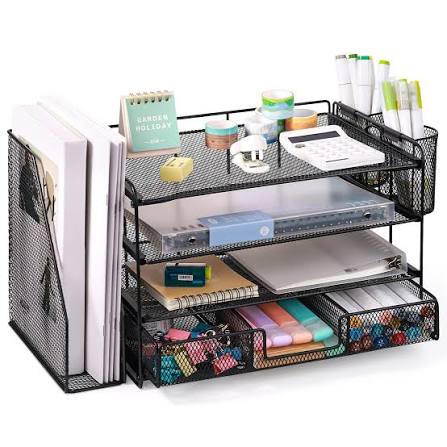
First, Clear Some of the Visual Noise
Before buying anything, clear the desk.
Not beautifully. Not Marie Kondo beautifully. Just enough that your child can actually see the surface they are supposed to work on.
There is some interesting research behind this.
A Carnegie Mellon study involving 24 kindergarten children found that they spent 38.6% of their time off task in a heavily decorated classroom compared with 28.4% in a sparse classroom. Their test accuracy was also higher in the less decorated room: 55% versus 42%.
That doesn’t mean your child’s LEGO pencil cup is destroying their academic future.
The study was small, involved classroom walls rather than children’s desks, and took place in laboratory classrooms. Still, it suggests something most parents have probably noticed anyway: when there is stuff everywhere, young eyes have a lot of stuff competing for their attention.
So I would start with a very simple rule:
Keep the things your child uses every day within reach. Move everything else somewhere else.
That may be the single cheapest study space makeover you ever do.
1. Give All Those Pencils, Markers and Scissors One Home
If school supplies live in six different drawers, three baskets and occasionally under the sofa, children have to go hunting before they can even begin.
A desktop caddy fixes a surprisingly annoying little problem: Where is my pencil?
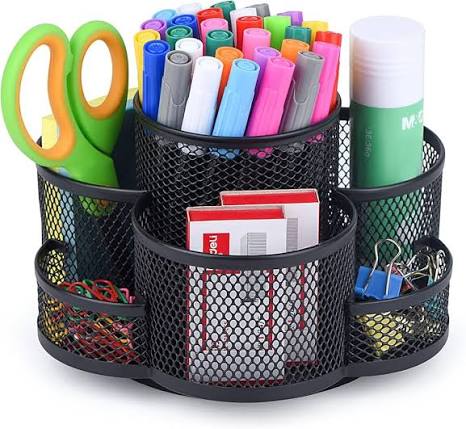
The Learning Resources Create-a-Space Storage Center is particularly handy because it spins, so your child can reach supplies without pulling everything out. There are separate compartments for pencils, markers, scissors, glue sticks and all the other tiny things that somehow multiply overnight.
For a more compact desk, the Topwey rotating holder gives you the same basic idea without taking over as much surface space.
| Product | Best for | Price* | Rating* |
|---|---|---|---|
| Learning Resources Create-a-Space Storage Center | Lots of everyday school supplies | $14.49 | 4.7 (17.2K) |
| Topwey Rotating Pen Holder | Smaller desks and basic supplies | $9.97 | 4.5 (2.9K) |
Prices and ratings were checked on Amazon US during research and can change.
Little Home tip: Don’t fill every compartment simply because it exists.
Keep out what your child actually uses for homework. Twenty seven markers, decorative scissors and the glitter glue they last touched in 2023 can live elsewhere.
Less to manage. Less to put away. Less chance of hearing, “Mom, I can’t find my pencil” while looking directly at twelve pencils.
2. Stop the Desk Drawer From Becoming a Tiny Junk Drawer
Desk drawers have ambition.
They begin September holding pencils and erasers in neat little rows. By November they contain two hair ties, a LEGO arm, a birthday party favor, six dried out markers and something sticky nobody wishes to investigate.
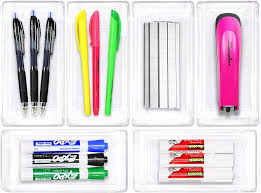
Drawer organizers give small things boundaries.
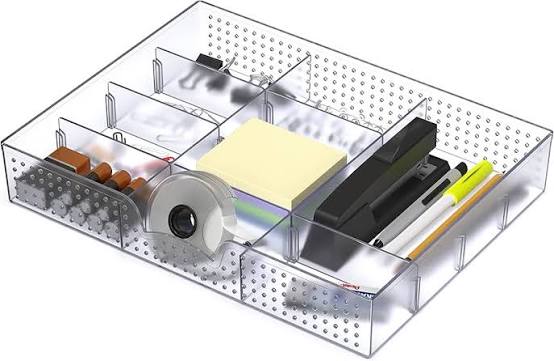
The Simple Houseware clear organizer set works well when you have lots of little supplies that need separate homes. The adjustable divider tray is better if you want one larger organizer that can change as your child’s supplies change.
| Product | Best for | Price* | Rating* |
|---|---|---|---|
| Simple Houseware Clear Drawer Organizer Set | Erasers, clips, pencils and small supplies | $13.97 | 4.8 (4.1K) |
| Simple Houseware Adjustable Drawer Divider Tray | One flexible drawer setup | $15.87 | 4.7 (6.1K) |
The important bit is not arranging everything by color.
Give each category an obvious place.
Pencils here. Erasers there. Glue over there.
A child should be able to open the drawer, put something away and close it without needing a filing system orientation session first.
That is the level of organization we’re aiming for.
3. Use One Desktop Organizer When You Need Everything Together
Some kids work better when supplies are visible.
Some moms also have children who interpret “put it in your desk drawer” as “push it somewhere into the darkness and never acknowledge it again.”
For those children, an open desktop organizer can work better.
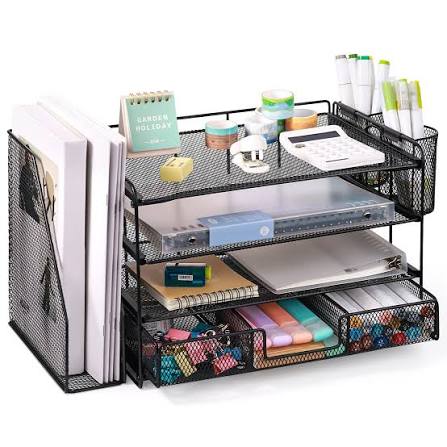
The Simple Houseware mesh organizer has upright compartments plus a sliding drawer, which means frequently used supplies stay visible while smaller bits can still be contained.
| Product | Best for | Price* | Rating* |
|---|---|---|---|
| Simple Houseware Mesh Desk Organizer With Sliding Drawer | Kids who need supplies visible and easy to grab | $25.87 | 4.6 (35.6K) |
I especially like this style of organizer for a desk without built in drawers because you’re adding storage without adding another piece of furniture.
And when the desk is already wedged between a bed and a dresser, every inch has a job.
4. Give School Papers Somewhere to Go Besides “Around”
Paper is where many homework stations fall apart.
Completed work. Work that needs completing. Reading sheets. Permission slips. Worksheets your child insists cannot be thrown away because the teacher might need them again.
You need somewhere between “leave it on the desk” and “file it permanently.”
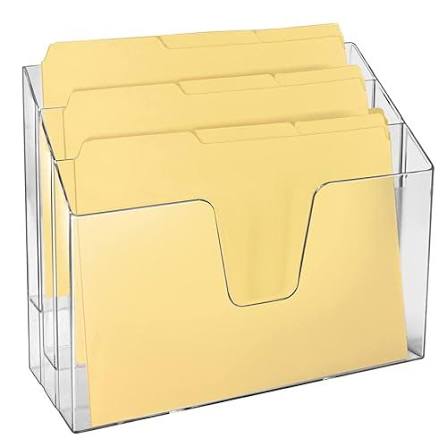
A tiered file organizer is useful because the papers remain visible.
The WALI four tier organizer could be divided by subject, math, reading, spelling and miscellaneous, or by what needs to happen next.
For example:
TO DO → FINISHED → RETURN TO SCHOOL
Honestly, that system may be more useful than organizing by subject for younger kids.
| Product | Best for | Price* | Rating* |
|---|---|---|---|
| WALI 4-Tier Desk File Organizer | Current homework and subject folders | $16.99 | 4.6 (4.6K) |
| Acrimet Triple File Sorter | A simpler three category paper system | $28.90 | 4.7 (5.4K) |
A system children can understand beats an elaborate system they need you to maintain.
Every single time.
5. Add a Tiny Whiteboard for the “What Am I Supposed to Be Doing?” Problem
You know the scene.
Child sits down.
Child gets back up.
Child asks what they need to do.
You explain.
Child returns to desk.
Five minutes later: “Wait…what was I doing?”
A little whiteboard beside the homework area can hold the day’s short list:
Math page 24
Read 15 minutes
Pack library book
Done.
No elaborate family command center required.
| Product | Best for | Price* | Rating* |
|---|---|---|---|
| SCRIBBLEDO Small Dry Erase Boards, 3 Pack | Daily homework lists and visual reminders | $9.98 | 4.8 (11K) |
A pediatric occupational therapy resource from The OT Toolbox also recommends visual schedules and checklists as part of helping children organize homework routines.
Source: The OT Toolbox — Tips to Organize Homework and Backpacks
Keep the list short.
We’re trying to get homework done, not create a project management dashboard for a seven year old.
6. Don’t Forget the Chair, Screen and Feet
Desk organization gets most of the attention because cute pencil cups photograph better than knees.
But comfort matters too.
According to pediatric orthopedic guidance from Banner Health, a child’s desk setup should ideally allow their elbows and knees to sit around a 90 degree angle, with feet supported, while screens should be around eye level and approximately an arm’s length away. The advice also recommends adjusting the setup as children grow.
Source: Banner Health — Crafting Comfortable Study Spaces for Students
Before buying a special children’s ergonomic chair, look at what you already have.
If your child’s feet dangle, try a sturdy box as a footrest.
If the chair is too deep, a rolled towel behind the lower back may help with support.
A sturdy stack of books can raise a monitor.
Those fixes are decidedly less glamorous than ordering an entirely new homework setup.
They are also considerably cheaper.
Banner Health also recommends getting kids up to stretch and move roughly every 30 minutes during longer study sessions.
So if your child suddenly needs to perform an interpretive dance halfway through spelling practice, perhaps we can call that an ergonomic break.
7. Fix the Lighting Without Turning the Desk Into an Operating Room
A desk lamp is useful. A desk lamp shining directly into your child’s eyeballs is less useful.
My Kids Vision recommends keeping glare producing light sources outside a child’s field of vision. A desk positioned at a right angle to a window can also help, rather than having your child work facing directly toward it.
Source: My Kids Vision — Indoor and Outdoor Lighting and Visual Development
For a homework desk, I like lamps with adjustable brightness because the same light doesn’t necessarily work for drawing at 3 p.m. and reading after dinner.
| Product | Best for | Price* | Rating* |
|---|---|---|---|
| iZELL LED Desk Lamp | Adjustable task lighting; 3 color modes and 10 brightness levels | $15.99 | 4.5 (15.9K) |
| White Crown Dimmable LED Desk Lamp | A simple dimmable desk light option | $17.99 | 4.4 (17K) |
If your child uses a computer or tablet for homework, the American Academy of Ophthalmology recommends regular breaks using the 20-20-20 rule: after 20 minutes, look at something about 20 feet away for at least 20 seconds. It also recommends keeping screens around an arm’s length away and reducing glare.
Source: American Academy of Ophthalmology — Digital Devices and Your Eyes
No fancy gadget required.
Sometimes the helpful accessory is simply a window across the room and permission to stare out of it for twenty seconds.
8. For a Tiny Study Space, Go Up Instead of Out
Maybe there isn’t room for another desktop organizer.
Maybe there isn’t even really a “homework room.”
There is a corner. Possibly half a corner.
That’s fine.
For small spaces, use the wall.
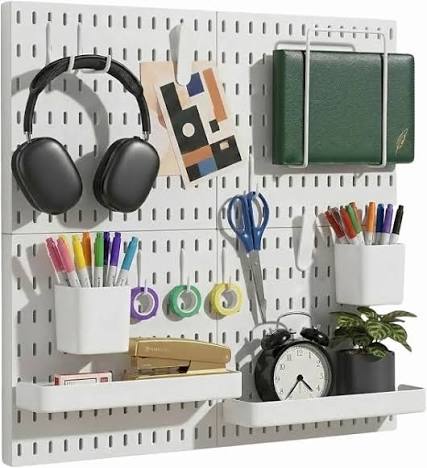
Floating shelves can hold books and less used supplies above the desk. A wall mounted file holder gets paper off the work surface. A pegboard can hold scissors, pencil cups and small baskets without eating into writing space.
Extra Space Storage similarly recommends using vertical storage, including shelves and pegboards, when creating children’s study areas in smaller spaces.
Source: Extra Space Storage — Kids Study Room Design Ideas
| Product | Best for | Price* | Rating* |
|---|---|---|---|
| EasyPAG 5-Tier Wall File Holder | Getting school papers completely off the desk | $22.99 | 4.8 (6.9K) |
| Amada Floating Shelves | Books and supplies above a small desk | $19.93 | 4.4 (12.1K) |
| Keepo Plastic Pegboard Kit | Flexible vertical storage | $38.99 | 4.2 (1.7K) |
Just don’t fill the wall because you suddenly have wall storage.
Empty space is allowed.
I checked.
9. No Permanent Desk? Make the Homework Supplies Portable
Not every child needs, or has room for, a dedicated desk.
The kitchen table may be the homework station from 4:00 to 5:00 and the place where everybody eats spaghetti at 6:00.
In that case, don’t fight your house.
Make the supplies portable.
A rolling cart can hold pencils, paper, books, folders and art supplies, then roll out of the way when homework is finished.
| Product | Best for | Price* | Rating* |
|---|---|---|---|
| Simple Houseware 3-Tier Rolling Cart | Shared homework areas and kitchen table study | $37.97 | 4.7 (32.3K) |
You don’t even have to buy a cart.
A shower caddy or handled basket can do the same job for considerably less money.
Put the daily basics inside: pencils, sharpener, eraser, scissors, glue, ruler, colored pencils and a small notepad.
Homework starts? Bring out the caddy.
Homework ends? Everything goes back inside and the whole thing leaves the table.
No gathering fourteen individual supplies while simultaneously trying to get dinner on plates.
Beautiful.
10. Give Important Reminders Their Own Spot
Some papers don’t belong in a file sorter because your child needs to see them.
The spelling list.
The school calendar.
The note reminding everyone that Thursday is inexplicably “dress like a historical figure day.”
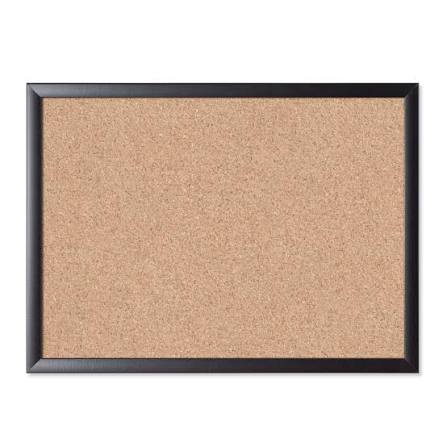
A small cork board above or beside the desk gives those papers somewhere obvious to live without spreading them across the work surface.
| Product | Best for | Price* | Rating* |
|---|---|---|---|
| U Brands Cork Board, 18 x 24 | Spelling lists, schedules and important reminders | $19.99 | 4.6 (8.8K) |
Keep this fairly sparse too.
Today’s spelling words? Useful.
A certificate from soccer camp three summers ago? Lovely, but perhaps not required directly above long division.
Affordable Kids Desk Organizers and Study Space Ideas: What I’d Buy First
You absolutely do not need all ten things in this article.
Please don’t read “affordable” and somehow emerge from Amazon $200 poorer. We’ve all been there.
Look at what is actually causing trouble at your child’s homework spot.
If pencils and supplies are everywhere:
Start with the Learning Resources rotating caddy.
If papers disappear:
Try the WALI tiered file organizer.
If your child forgets what comes next:
Use one of the SCRIBBLEDO dry erase boards for a short daily checklist.
If the desk is tiny:
Skip another desktop organizer and use the EasyPAG wall file holder or shelves instead.
If homework happens at the kitchen table:
A portable caddy you already own may be enough. If you need more storage, the three-tier rolling cart gives everything one movable home.
If the desk feels dark:
Start with an adjustable lamp before buying more organizers.
Fix the annoying problem first.
You can always add something later.
A Five Minute Homework Station Reset Kids Can Actually Do
The best study space system is the one that doesn’t require Mom to restore it every night.
Give your child a tiny reset routine:
- Pencils and markers back in the caddy.
- Papers into the correct file slot.
- Trash into the trash can.
- Tomorrow’s task on the whiteboard.
- Clear enough desk space to start again.
That’s it.
You could even write those five steps on the little whiteboard until they become familiar.
A pediatric OT recommends keeping needed homework supplies together and using visual checklists to help children who struggle with homework organization.
Source: The OT Toolbox — Homework Organization Tips
The goal isn’t a desk that looks untouched.
A child’s desk should look like a child uses it.
We’re just trying to prevent “uses it” from becoming “has established a small civilization on top of it.”

One More Reason to Make Homework Easier on Everyone
If homework feels like one more thing on an already full parental plate, you’re hardly imagining it.
In a 2025 Ipsos survey of 1,015 U.S. parents, 40% said their stress or mental load was higher during the school year than during summer. Among parents reporting increased school year stress, 44% named helping with homework or academic struggles as a major contributor.
Source: The Kids Mental Health Foundation — School Year Parent Burnout Survey
An organizer isn’t going to make fractions explain themselves.
But a child being able to sit down, find a pencil, see what needs doing and start without three rounds of “Mooooom?” is still a win.
I’ll take it.
The Bottom Line
A functional kids’ study space doesn’t need matching containers, expensive furniture or a makeover worthy of its own reveal video.
Give everyday supplies one obvious home.
Keep current papers visible.
Use the wall when desk space is tight.
Make sure your child can sit comfortably and see what they’re doing.
Then stop.
A few affordable kids desk organizers and study space ideas can make the space easier for your child to use and easier for you to live with. That’s much more useful than a perfect desk that nobody is allowed to touch.
Tackling kids’ clutter beyond the desk too? Our guide to kids capsule wardrobe essentials on a budget covers the same no fuss approach for their closet.
And if there is still one mystery crayon on the floor at the end of the day?
I’d call that organized enough.
This article contains affiliate links. If you buy through one of these links, Little Home US may earn a small commission at no extra cost to you.