How to Read Skincare Ingredient Lists Without Feeling Like a Chemistry Major

You know that moment when you pick up a skincare product, turn it around, and suddenly you’re staring at a paragraph full of words you couldn’t pronounce if you tried?
Same.
And when you’re busy, the last thing you need is another thing to research for 45 minutes before deciding whether a moisturizer is actually worth putting in your cart.
The good news is, you do not need to understand every ingredient on the bottle.
You just need to know what to look for.
Your 30 Second Skincare Label Decoder
| LOOK FOR | WHAT IT TELLS YOU |
|---|---|
| The beginning of the ingredient list | Which ingredients generally appear in the greatest amounts |
| An ingredient you care about | Whether it is actually in the formula |
| Marketing claims | What the brand is emphasizing or promising |
| A Drug Facts panel | Whether the product is regulated as a drug as well as a cosmetic |
I Went Digging So You Don’t Have To
When I first started looking into skincare ingredients, I realized pretty quickly that there was a lot more to these little labels than I thought.
So I went digging.
I read through FDA guidance, dermatology resources, research papers, and the actual rules around cosmetic labeling. And honestly, I came away with a lot more useful information than I expected.
That is what I’m sharing with you here.
Not every scientific detail. Not a giant list of ingredients you need to memorize. Just the information that can actually help when you’re standing in the skincare aisle trying to figure out what you’re looking at.
Because I especially wish someone had handed me a simple guide when I was starting out.
So I made one.
Keep the Skincare Label Decoder nearby as you read. By the time you finish this article, you’ll have a much clearer idea of what an ingredient list can tell you, what it cannot tell you, and which marketing claims deserve a little more context.
Let’s get into it.
1. Start at the Top of the Ingredient List
One of the easiest places to start is the beginning.
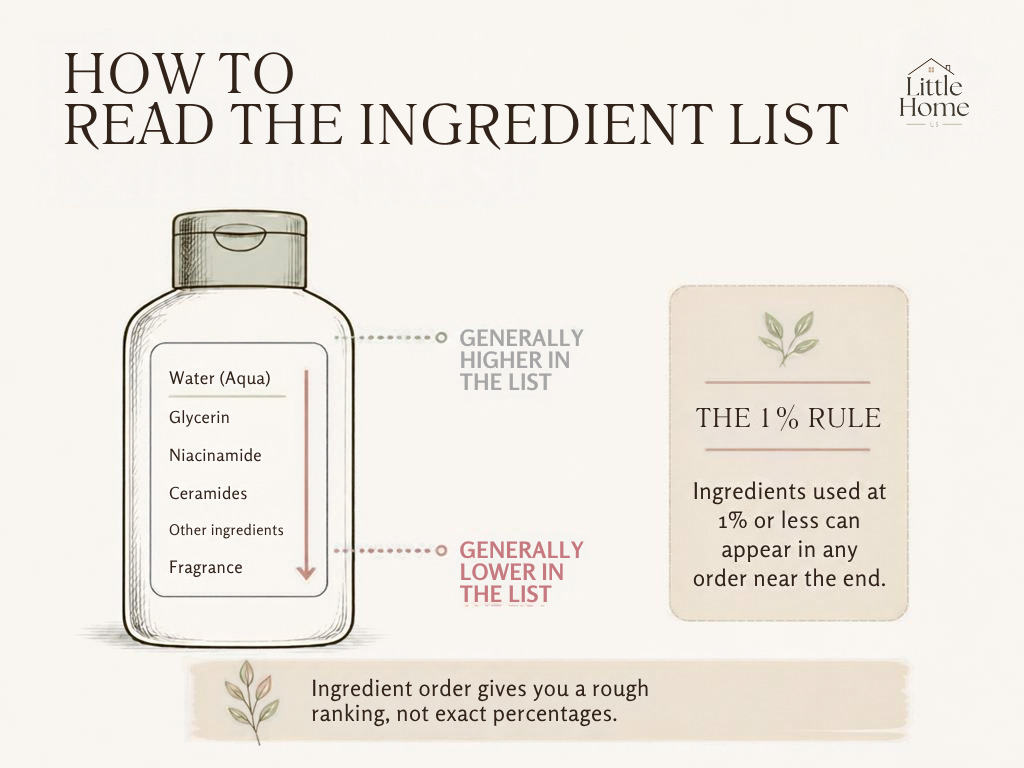
In the United States, cosmetic ingredients are generally listed in descending order of predominance. In plain English, ingredients used in greater amounts generally appear before ingredients used in smaller amounts.
There is an important exception, though.
Ingredients present at 1% or less can generally be listed in any order after the ingredients present at more than 1%. Color additives also have their own labeling rules.
So when you turn that bottle around, you can think of the ingredient list as giving you a rough ranking, not an exact recipe.
What the order can tell you
If water is first, for example, that tells you water is one of the main ingredients in the formula.
If glycerin appears near the beginning, it is likely being used in a meaningful amount.
If a particular ingredient appears much farther down the list, that tells you it is lower in the ingredient declaration, but it does not automatically tell you the exact percentage.
And this is where one of the biggest skincare label myths comes in:
The first three ingredients do not automatically make up 90% of the product.
Ingredient order tells you the relative order of ingredients under the labeling rules. It does not give you the exact percentage of each ingredient.
That distinction matters.
What about those complicated names?
This is another place where skincare labels can make perfectly normal ingredients sound intimidating.
You might see:
Water (Aqua)
or
Sweet Almond (Prunus Amygdalus Dulcis) Oil
Those names are there because cosmetic ingredients are labeled using established common, usual, or other recognized ingredient names under FDA rules.
So don’t assume a long scientific sounding name automatically means something scary.
Sometimes it is simply the formal name for an ingredient you already recognize.
2. Learn the Job, Not Every Ingredient
This is where I think skincare gets unnecessarily complicated.
You could spend hours trying to memorize hundreds of ingredients.
Or you can start by asking a much simpler question:
What job is this ingredient doing?
A few common ingredient groups show up again and again.
Humectants
Humectants help attract and hold water.
You may see ingredients such as:
- Glycerin
- Hyaluronic acid
If a product is designed to help add or maintain hydration, humectants are one group you may come across.
Emollients
Emollients help soften and smooth the skin.
Common examples include various oils, butters, fatty alcohols, and other ingredients that help improve the feel of a formula.
Occlusives
Occlusives help slow water loss from the skin by forming a layer over the surface.
This is one reason some moisturizers feel richer or more protective than others.
You do not need to decide that one category is universally “better.”
They simply do different jobs.
Ceramides
Ceramides are lipids naturally found in the skin barrier.
You will often see them discussed in products designed to support the skin barrier.
Niacinamide
Niacinamide is a form of vitamin B3.
It is commonly used in skincare and has been studied for several cosmetic and skin related uses, including supporting the skin barrier and improving the appearance of uneven skin.
Research on niacinamide has continued to explore its role in skin health and appearance.
The important takeaway for label reading is simply this:
Niacinamide tells you what ingredient is present. It does not, by itself, tell you exactly how the finished product will perform.
Retinol
Retinol is a vitamin A derivative used in over the counter skincare.
It is commonly associated with concerns such as fine lines, texture and uneven looking skin over time.
You’ll also see other retinoids on ingredient lists, so “retinol” and “retinoid” are not always interchangeable terms.
Preservatives
This is one people sometimes misunderstand.
Preservatives help protect products from unwanted microbial growth.
That is an important job, particularly for products that contain water.
Parabens are one example of preservatives used in cosmetics. FDA describes parabens as a family of preservatives commonly used to help prevent the growth of bacteria and mold in cosmetic products.
So seeing the word “preservative” or the name of a preservative on a label does not automatically tell you that a product is unsafe.
It tells you that the formula needs protection from microbial growth.
Fragrance or Parfum
“Fragrance” or “parfum” can refer to a blend used to give a product its scent.
In some cases, fragrance ingredients can be listed collectively rather than individually, which means the word “fragrance” does not necessarily tell you every component of that blend.
This is another good example of why the ingredient list is useful, but not an X ray of the entire formula.
3. “Active Ingredient” Does Not Always Mean What You Think
This one gets confusing because skincare brands use the word active very casually.
But in U.S. drug labeling, “active ingredient” has a more specific meaning.
Some products are regulated as both cosmetics and drugs because of what they are intended to do or the claims made about them.
For example, certain acne treatments and sunscreens fall into this category.
When a cosmetic is also a drug, the drug active ingredients are identified separately before the cosmetic ingredients.
So if you see a Drug Facts panel, you are looking at something different from an ordinary cosmetic ingredient list.
That’s worth knowing because you cannot treat every product labeled “active” by a beauty brand as though it were a regulated drug product.
4. Now Let’s Talk About the Words on the Front
This is where skincare shopping can get really interesting.
Because the front of the bottle is marketing.
The back is where you get more of the actual ingredient information.
That doesn’t mean marketing claims are automatically false.
It means you should understand what those words actually tell you.
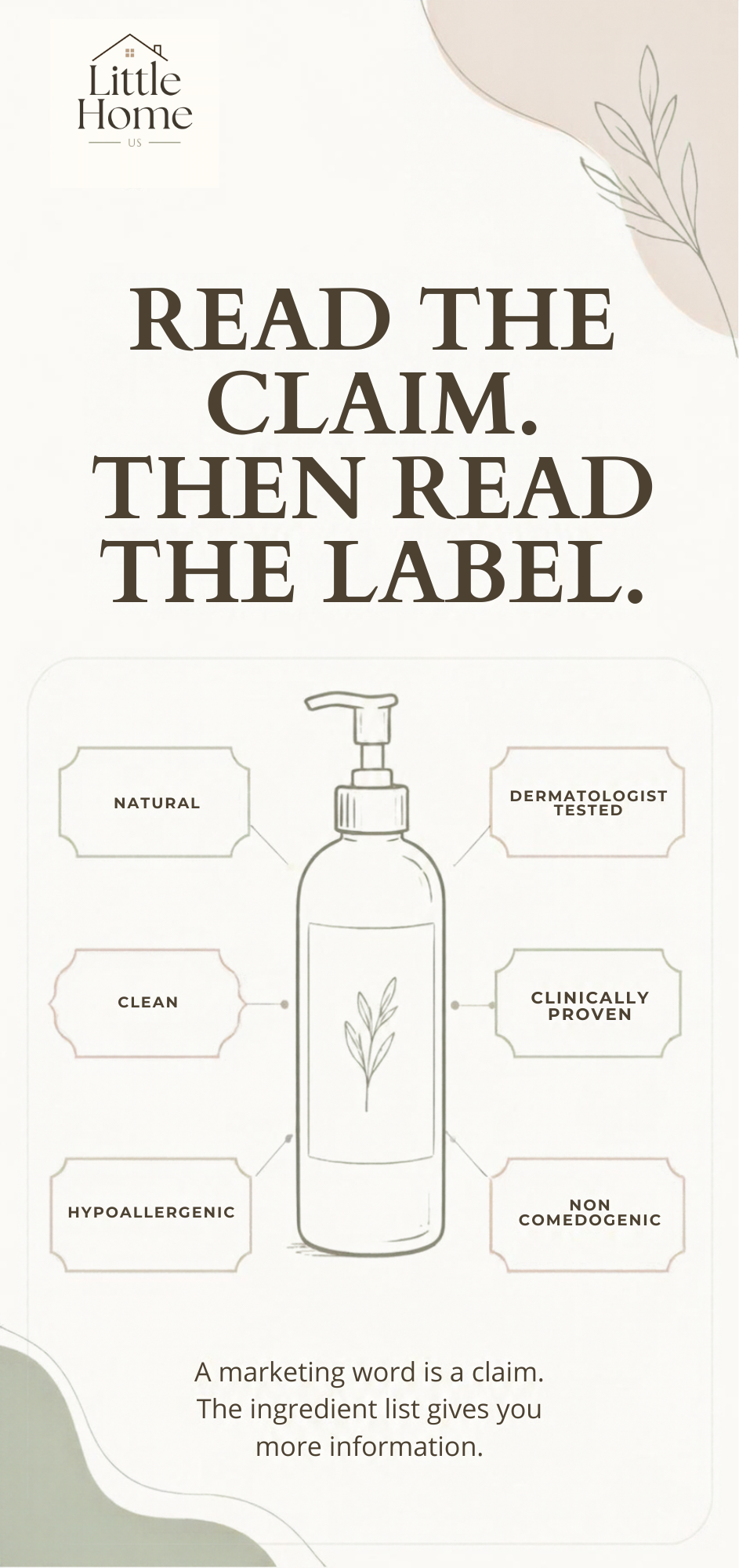
“Natural”
There is no single FDA definition that makes “natural” a complete explanation of a cosmetic formula.
So seeing “natural” on the front of a bottle does not tell you how the finished product will perform or whether every ingredient is automatically gentle.
“Clean”
“Clean” is another word that can mean different things depending on the brand.
It is not one standardized FDA category for cosmetics.
So rather than stopping at the word “clean,” turn the bottle around and look at the actual ingredient list.
“Hypoallergenic”
This one sounds more official than it is.
FDA says there are no federal standards or definitions governing the use of the term “hypoallergenic” on cosmetics.
So the word alone cannot guarantee that a product will not cause a reaction.
“Dermatologist Tested”
Okay, but tested how?
By how many people?
For what purpose?
Under what conditions?
The phrase itself does not answer those questions.
That does not automatically make the claim meaningless. It simply means you need more information before treating the phrase as proof of a particular result.
“Clinically Proven”
This sounds impressively scientific.
But again, the phrase itself does not tell you what was studied, who participated, what the comparison was, or what the results actually showed.
Scientific and objective claims should have appropriate evidence behind them. The Federal Trade Commission has taken action against cosmetic advertising when scientific claims were not adequately supported.
“Non Comedogenic”
This generally means the product is being marketed as less likely to clog pores.
But there is not one universal FDA standardized test that gives the phrase a simple pass or fail meaning across every cosmetic product.
Research reviewing common dermatology marketing terms has also found that claims such as “fragrance free,” “hypoallergenic,” and “non comedogenic” can have limited or variable clinical usefulness.
“Fragrance Free”
This can be useful information, but it is still worth looking at the ingredient list rather than assuming the front label tells you everything about the formula.
The Little Home Rule
A marketing word is a claim. The ingredient list gives you more information. Look at both.
5. Wait, So What Does a Percentage Actually Tell Me?
Now we get to one of the most confusing parts of skincare marketing.
You see:
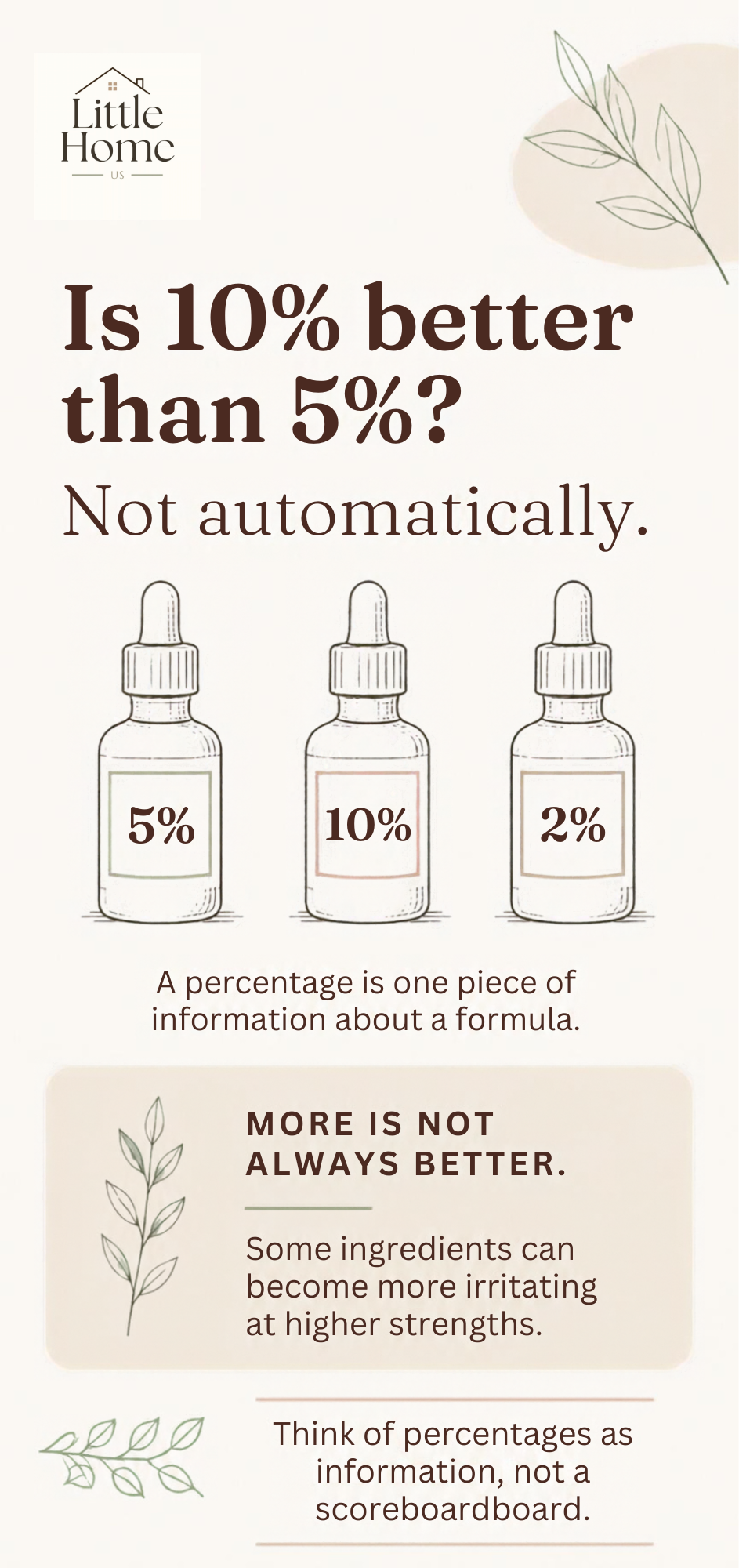
5%
10%
2%
and your brain immediately goes:
Higher number = better product.
Not necessarily.
A percentage tells you the stated concentration of an ingredient.
It does not tell you the entire story of how the finished formula will perform.
Example: 10% Niacinamide
If a product says it contains 10% niacinamide, that gives you a specific concentration.
But it does not automatically mean that it will perform better than every product containing less niacinamide.
The rest of the formula matters too.
Example: 2% Salicylic Acid
Salicylic acid is a good example of why percentages can mean something different when you are dealing with regulated over the counter drug products.
Certain acne products are regulated under specific drug requirements, including requirements around active ingredients and concentrations.
So you cannot apply one blanket rule to every skincare percentage you see.
And no, the first three ingredients are not “90% of the product”
This is worth repeating because you will see that claim all over skincare content.
Ingredient order is useful.
But it is not a percentage chart.
Ingredients above 1% are generally listed in descending order of predominance. Ingredients at 1% or less can appear in any order after that group.
So:
Ingredient number one does not automatically equal 60%.
Ingredient number three does not automatically equal 10%.
And the first three ingredients do not automatically equal 90%.
One More Thing
More is not always better.
Some ingredients can become more irritating at higher strengths, so a bigger number on the bottle should not automatically be treated as a gold medal.
Think of percentages as one piece of information, not a scoreboard.
6. What an Ingredient List Can Actually Tell You
At this point, you might be wondering:
Okay, so what am I actually supposed to get from all of this?
Quite a bit, actually.
An ingredient list can help you:
See what ingredients are in the formula
You can look for a particular ingredient instead of relying only on the front label.
Understand the general order of ingredients
The beginning of the list can give you a rough idea of which ingredients are present in greater amounts.
Spot certain ingredients you may want to learn more about
For example, you might be comparing products and want to know whether one contains niacinamide, ceramides or a particular preservative.
Understand whether you are looking at a cosmetic or a drug product
A Drug Facts panel is an important clue.
Read marketing claims with more context
Instead of seeing “natural,” “clean,” or “clinically proven” and immediately treating it as a conclusion, you can turn the bottle around and look at the actual formula.
That is a much more useful habit.
7. What an Ingredient List Cannot Tell You
And this is just as important.
An ingredient list is not magic.
It cannot tell you:
- The exact percentage of most ingredients
- Whether the product will work well for you personally
- How effective the finished formula is
- The exact pH of the product
- How the ingredients interact with one another
- How the packaging affects the formula over time
- How stable every ingredient is
- Everything about how the product was tested
- Whether a product will feel good on your skin
- Whether you personally will tolerate every ingredient
This is why I don’t want you walking away from this article thinking:
“Okay, now I can judge any skincare product just by reading the back.”
You can’t.
And that’s okay.
The goal is not perfect product detective work.
The goal is to have more useful information than you had before.
8. Your Five Step Skincare Label Check
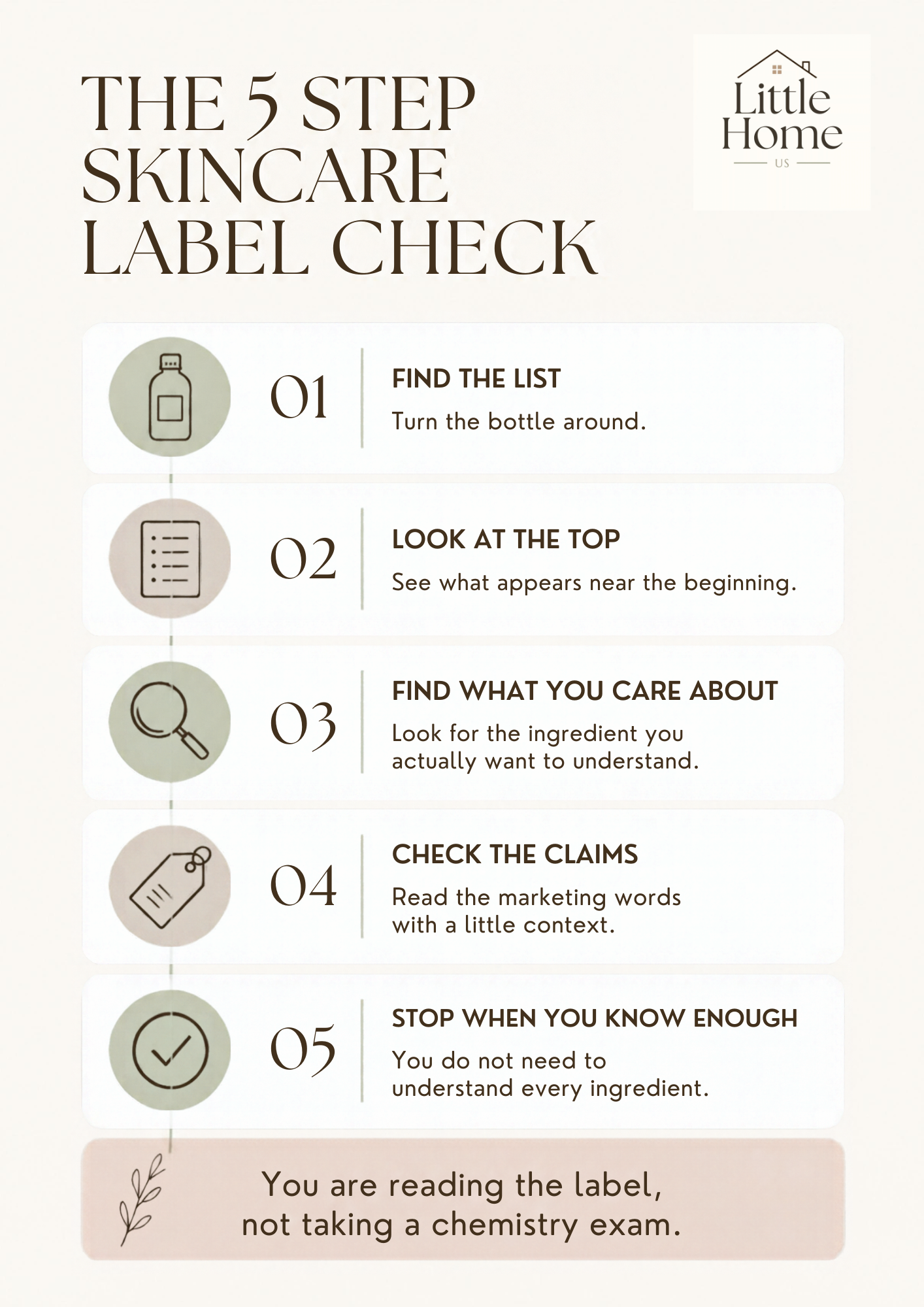
Here is the little routine I would actually use in a store.
01. Find the ingredient list
Turn the bottle around.
Ignore the pretty front for a second.
Find the actual ingredient declaration.
02. Look at the top
Read the first few ingredients.
Remember that the order generally reflects descending predominance, with important exceptions for ingredients present at 1% or less and color additives.
03. Find what you actually care about
Looking for glycerin?
Niacinamide?
Ceramides?
Retinol?
Find it.
You don’t need to understand every other word before you can notice the ingredient that matters to you.
04. Check the claims
Now go back to the front.
Does it say “clean”?
“Natural”?
“Clinically proven”?
“Hypoallergenic”?
“Non comedogenic”?
Treat those as claims that deserve context, not as complete explanations of the formula.
05. Stop when you know enough
This might be my favorite step.
You do not have to decode every single ingredient.
If you know what you were looking for, understand the basic role of the ingredient, have looked at the claims with a little context, and know what the label can and cannot tell you, you can stop.
You are reading a label.
You are not taking a chemistry exam.
9. A Quick Note About “Clean” and “Toxic”
Because skincare conversations online can get very dramatic very quickly.
One ingredient gets called “toxic.”
Another gets called “clean.”
Another gets called “chemical.”
And suddenly buying moisturizer feels like preparing for a laboratory inspection.
Let’s take a breath.
Everything in a cosmetic formula is made up of chemical substances. “Chemical” does not automatically mean dangerous, just as “natural” does not automatically mean harmless.
The more useful question is:
What is the ingredient, what is it doing in the formula, how is it being used, and what evidence do we have about it?
That’s a much better question than simply putting ingredients into a “good” or “bad” bucket.
For example, preservatives have a job. They help protect products from unwanted microbial growth. Fragrance has a job. Humectants have a job. Emollients have a job.
Once you start thinking about ingredients by function, the label becomes much less intimidating.
10. The Part I Wish Someone Had Explained to Me First
You don’t have to become a skincare ingredient expert to become a smarter skincare shopper.
Honestly, that was one of the biggest things I realized while researching this.
The internet can make skincare feel like there is always another ingredient you need to know.
Another percentage you need to understand.
Another ingredient you supposedly need to avoid.
Another product that promises to transform everything.
And the more you read, the more confusing it can become.
But when you strip it back, reading a label is actually a fairly simple process.
Look at the ingredient list.
Understand the basic job of common ingredients.
Pay attention to the order without pretending it gives you exact percentages.
Look at marketing claims with context.
Know the difference between a cosmetic and a drug product.
And then stop.
You are allowed to know enough.
Your Skincare Label Decoder
And this is exactly why I made the little guide that goes with this article.
When I started digging into all of this, I kept thinking:
I wish someone had just given me a simple sheet with the basics.
Something I could look at while shopping.
Something that would remind me what the common ingredient groups actually do.
Something that would make those marketing words a little less impressive.
Something that would stop me from believing that a bigger percentage automatically means a better product.
So instead of making you dig through FDA pages and research papers the way I did, I pulled the useful bits together into one beginner friendly Skincare Label Decoder.
Want the cheat sheet beside you while you shop?
The Skincare Label Decoder: A Beginner’s Cheat Sheet gives you the basics in one simple place, so you can keep it on your phone, save it, or print it for your next skincare shopping trip.
You do not need to know everything about skincare.
You just need enough information to know what you’re looking at.
A Few Questions You Might Still Have
Do I need to understand every ingredient on a skincare label?
No.
Start with the ingredients you actually care about and learn their basic roles. You can always look up individual ingredients later when you need more information.
Does the first ingredient have the highest percentage?
It is generally the ingredient present in the greatest amount under the ingredient declaration rules, but the label does not give you its exact percentage. There are also exceptions to the usual order, including ingredients present at 1% or less.
Does a higher percentage mean a skincare product is better?
Not automatically.
A percentage tells you the stated concentration of an ingredient. It does not tell you the whole story of how a finished formula will perform.
Are “natural” ingredients always better?
“Natural” is not a guarantee of performance, safety or gentleness. Look at the actual ingredients and the evidence behind the product’s claims.
Is “hypoallergenic” a guarantee that I won’t react?
No. FDA says there is no federal standard or definition governing the use of “hypoallergenic” on cosmetics.
What is the difference between an active ingredient and a regular skincare ingredient?
For products regulated as drugs, “active ingredient” has a specific regulatory meaning. Some products are regulated as both cosmetics and drugs, and their drug active ingredients are identified separately.
Why are preservatives in skincare?
Preservatives can help prevent unwanted microbial growth and protect the product. They are an important part of many water based cosmetic formulas.
Before You Go
If there is one thing I hope you take from this, it is that reading a skincare label does not have to become another thing you’re expected to master.
You do not need to memorize every ingredient.
You do not need to understand every scientific term.
And you definitely do not need to stand in the skincare aisle Googling half the bottle before you can buy a moisturizer.
You just need a few useful clues.
I went digging because I wanted to understand what all of this actually meant. And if I could go back to when I first started, I would have wanted someone to hand me a simple little guide and say:
“Start here. These are the things that matter.”
So that’s what I made for you.
Keep the Skincare Label Decoder nearby the next time you’re shopping.
Take what helps.
Leave the pressure behind.
You did not need a chemistry degree before. You still don’t.
Sources and Further Reading
The goal of this article is to make skincare labels easier to understand, but if you want to go deeper, these are the sources I used while researching it.
FDA: Cosmetic Labeling Guide
The rules and explanations behind ingredient declarations, order of ingredients, the 1% rule and cosmetic labeling.
FDA: Summary of Cosmetics Labeling Requirements
An overview of U.S. cosmetic labeling requirements, including ingredient order and products that are also drugs.
FDA: Cosmetic Ingredient Names
Information about how cosmetic ingredients are named and identified on labels.
FDA: “Hypoallergenic” Cosmetics
What the term means, and why there is no federal standard definition for it.
FDA: Parabens in Cosmetics
Background on parabens and their use as cosmetic preservatives.
FDA: Allergens in Cosmetics
Information about fragrance labeling and cosmetic claims such as “hypoallergenic” and “fragrance free.”
PubMed: Clinical Utility of Marketing Terms Used for Over the Counter Dermatologic Products
A review examining commonly used skincare marketing terms and their clinical usefulness.
AAD: How to Pick a Moisturizer
A dermatologist reviewed resource for understanding moisturizer ingredients and choosing a moisturizer.
AAD: Retinoid or Retinol?
A dermatologist reviewed explanation of retinoids and retinol.
A little Little Home reminder
You do not have to know everything about skincare. You just need enough information to feel a little more confident when you turn that bottle around.

Your free guide is one step away ♡
Pop in your email and it’s yours. I’ll also send you new printables now and then.
No spam, unsubscribe anytime.More from Little Home US
If you like this one, these may help: Non-Toxic Living for Beginners, Fragrance Free Laundry, Cleaning Basics.